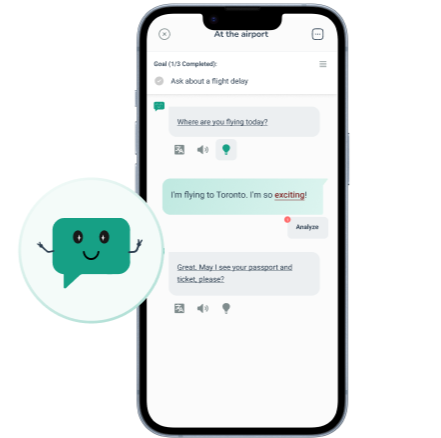
Download LingUp to continue the roleplay and get instant feedback on your grammar and pronunciation.
Try LingUp Now!Start with 're-'. The sound is short, like the 're' in 'return'. Your tongue is in the middle of your mouth.
Stress the second syllable: '-luc-'. Make the short 'uh' sound /ʌ/, like in the word 'cup'. End with a sharp 'k' sound.
Finish with '-tant'. Your tongue touches behind your teeth for the 't', followed by a soft 'uh' sound (schwa /ə/), and ends with 'nt'.
Stressing the first syllable (RE-luc-tant instead of re-LUC-tant).
Pronouncing the 'u' like in 'flute' (re-LOOC-tant). It should be a short sound, like in 'luck'.
Making the first 'e' sound long like 'ee' (REE-luc-tant). It is a short /ɪ/ sound.
same as American
same as American
It's the /ʌ/ sound, like the 'u' in 'cup' or 'luck'. Your mouth should be relaxed and slightly open. It is a short sound.
The stress is on the second syllable: re-LUC-tant. Say '-LUC-' louder and a little longer than the other parts.
No, the final 't' is pronounced clearly. Your tongue should tap the roof of your mouth just behind your teeth to make the /t/ sound.
Feeling or showing that you do not want to do something; unwilling.
/rɪˈlʌk.təns/
The feeling of not wanting to do something.
/rɪˈlʌk.tənt.li/
Doing something in an unwilling way.
- 'reluctance' ends with a /s/ sound, not a /t/ sound.
- 'reluctantly' adds an extra syllable, '-ly' (/li/), at the end.
Focus on stressing the second syllable, '-LUC-'. This is the most important part of sounding natural. Practice saying 're-LUC-tant' over and over.
The 'u' is not a long 'oo' sound. It's a short 'uh' sound /ʌ/. Think of the word 'luck'. The middle of 'reluctant' sounds just like 'luck'.